
Available Services
This chapter introduces the major framework services available to application developers. While each subsystem is documented individually, this overview explains how the various components work together.
Configuration Management
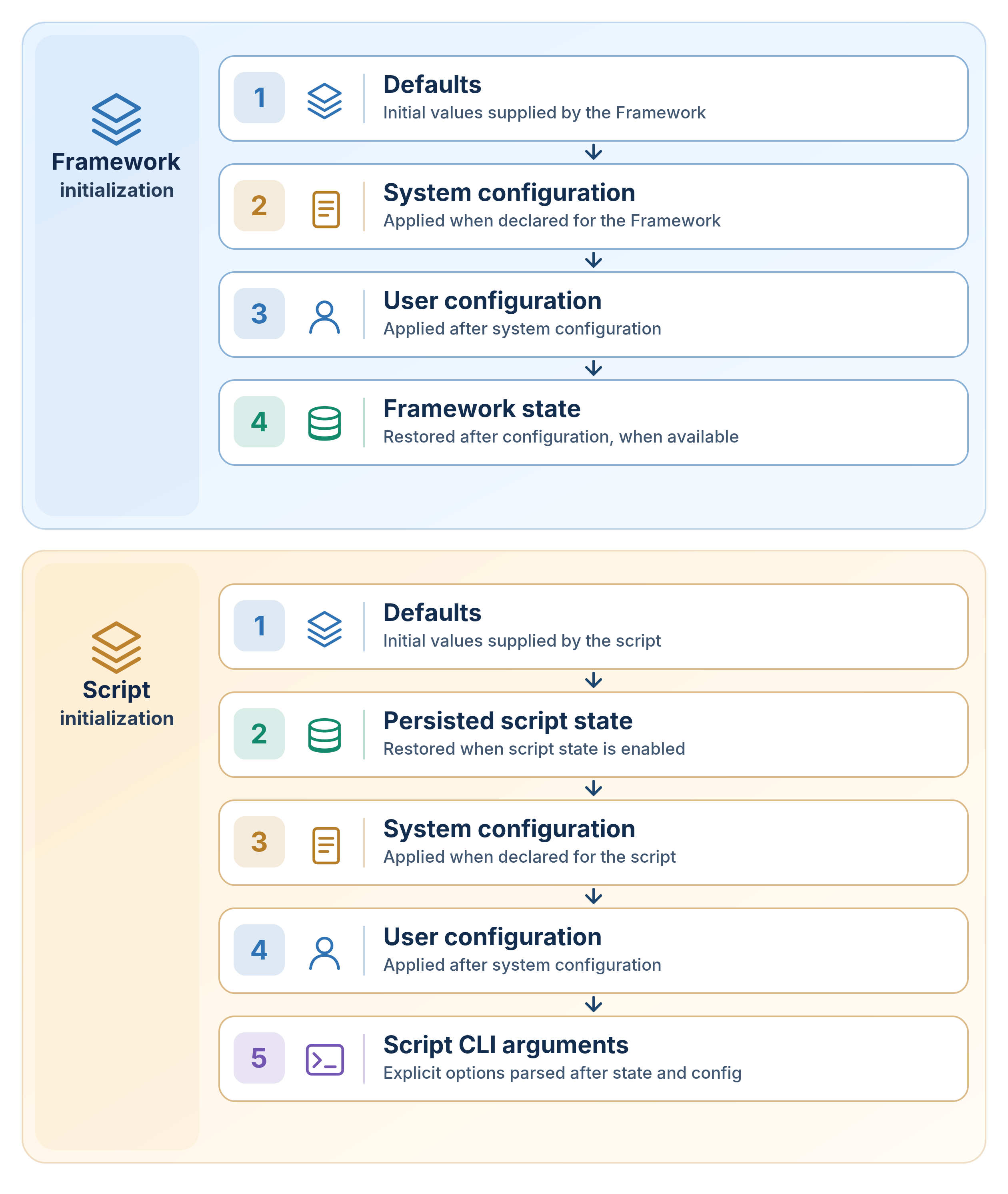
The configuration subsystem provides a consistent mechanism for loading, validating, modifying, and persisting application settings.
Configuration values typically represent user preferences or application settings that remain relatively static between executions.
State Management
The state subsystem stores runtime information that applications may wish to remember between executions.
Unlike configuration values, state represents remembered runtime choices and workflow context such as previous selections, recently used values, UI choices, or cached information. Scripts opt individual values into persistence explicitly.
Command-Line Arguments
The argument subsystem provides standardized command-line processing. After the bootstrap separates framework options from script arguments, applications can define their own declarative argument specification while retaining framework built-ins such as help, version reporting, tracing, debugging, and configuration overrides. DRYRUN is a framework-wide execution contract rather than merely a display flag. When DRYRUN is active, cooperating framework tools and delegated actions must avoid persistent changes, including configuration/state writes and system modifications.
User Interface Services
The UI subsystem provides a collection of functions intended to simplify communication with the user.
Common operations such as informational messages, warnings, errors, confirmations, prompts, selections, and formatted output are provided through a consistent interface.
Console Applications
sgnd-menu.shprovides a reusable public menu service independent of the SolidGround Management Console host. Applications can create menu models, register groups and items, render pages, read selections, and dispatch registered actions through the publicsgnd_menu_*API. The Management Console is one consumer of that API. Its page modules are discovered from lightweight metadata and sourced lazily when first opened.
Documentation Generation
MCM manages documentation bundles and generates Markdown documentation directly from structured source comments in the repositories.
Product information, architecture descriptions, API documentation, appendices, glossaries, and implementation notes are all maintained close to the source code; MCM produces the Markdown documentation that WCM renders as a navigable site.
This approach helps ensure that documentation remains synchronized with the implementation and reduces the risk of documentation becoming outdated.